What Anthropic’s AI Jobs Study Misses in the Global South
Anthropic’s recent study on AI and jobs offers valuable insights into how artificial intelligence may affect labor markets in advanced economies. But the same framework does not fully capture how workforce disruption unfolds in the Global South—where informality, youth employment pressures, and service outsourcing shape labor market realities.

AI in Workforce
Part 1 of 4
Table of Contents
- AI and Labour in the Global South: A Reality Check on Anthropic’s Analysis
- Related in this cluster
- 📥 AI in Workforce Series: What Anthropic AI Labour Study misses from a Global South Perspective (PDF)
- 💬 Join the Conversation
- 🌍 Follow GlobalSouth.AI
- Subscribe to stay updated on new case studies, frameworks, and Global South perspectives on responsible AI.
AI and Labour in the Global South: A Reality Check on Anthropic’s Analysis
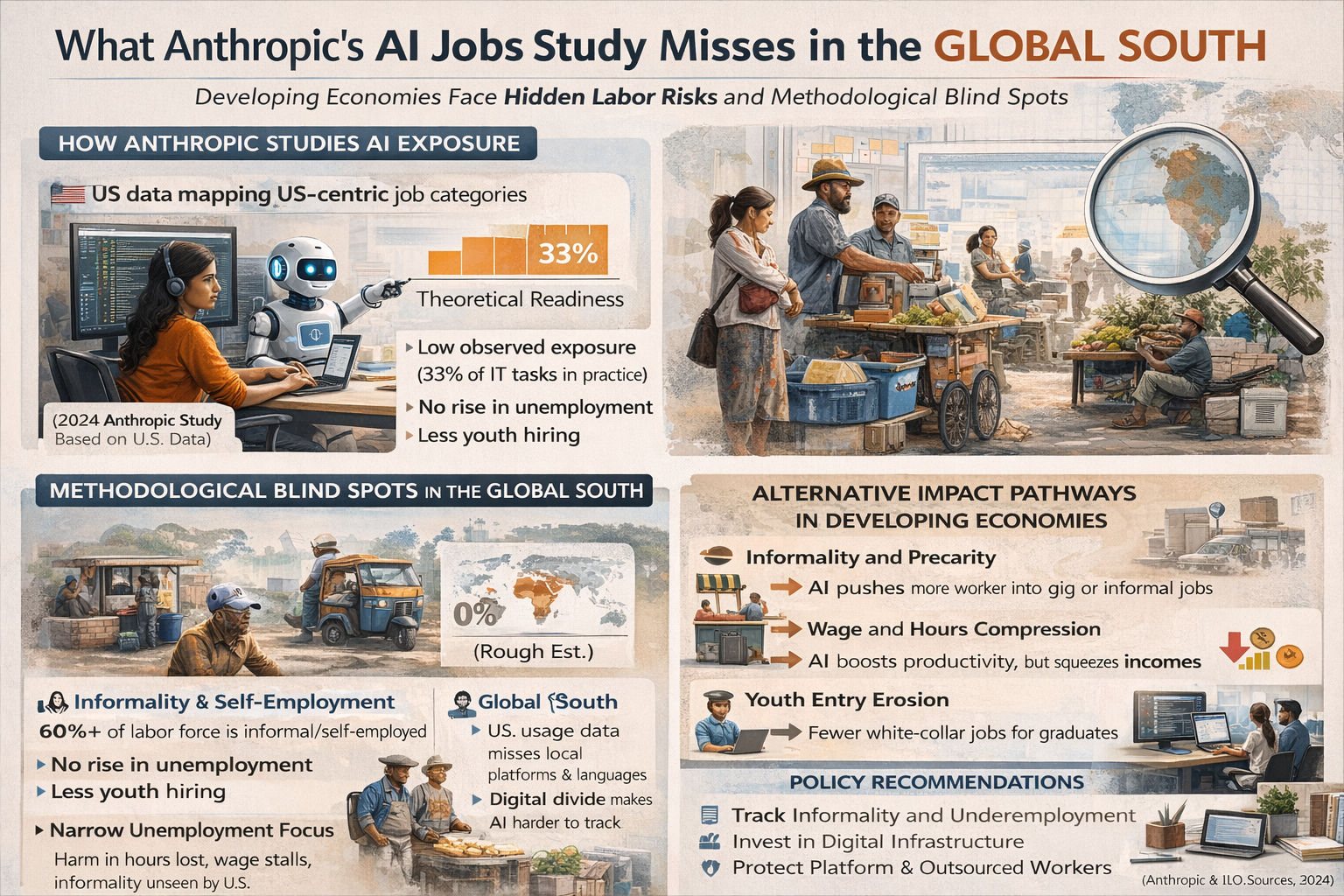
Executive Summary: Anthropic’s recent AI labour study introduces an “observed exposure” metric (combining U.S. tasks and real usage) and finds that AI has so far had no discernible effect on U.S. unemployment [1]. It identifies tech and clerical-intensive occupations (programmers, customer‐service reps, data-entry clerks) as most exposed, and reports a tentative ~14% drop in hiring for 22–25 year‐olds in those jobs. These conclusions rely on U.S. data (O*NET occupations, Claude/Anthropic usage logs, BLS/CPS statistics).
However, this U.S.-centric picture misses key Global South (GS) realities. In developing economies, the headline unemployment rate is a poor proxy for labour distress. Roughly 60% of workers worldwide are in informal jobs [2], and ILO data show a staggering “jobs gap” of 402 million people wanting work in 2024 (186M unemployed plus discouraged/underemployed) [3]. Moreover, GS labour markets feature heavy underemployment, wage stagnation and working poverty that do not register as unemployment: for example, Sub-Saharan Africa accounts for ~67% of the world’s working poor. In practice, AI-driven disruption in the Global South is likely to appear through wage compression, hours cuts, forced reclassification of work, or shifts into informal gigs and off-books labour – channels Anthropic’s analysis does not measure.
This brief assesses Anthropic’s methods against Global South contexts and proposes alternative indicators and policies. We argue that policymakers should supplement unemployment metrics with informality and underemployment rates, youth NEET/placement data, earnings and working-hours indicators, and sectoral employment (especially in services/BPO). We sketch an “AI–Labour Index” for developing economies (see Table 2) and urge coordinated data collection. Policy recommendations include investing in digital infrastructure and AI-complementary skills, extending labour protections to platform/BPO workers, and building local AI solutions. The hard truth is: without a broader toolkit of indicators and protections, the Global South risks being blindsided by AI’s indirect impacts. The question is blunt: will stakeholders commit now to measuring and safeguarding workers in the AI era?
Anthropic’s Analysis: U.S.-based Measures and Findings
Anthropic introduces “observed exposure” to quantify AI disruption risk. A job’s exposure equals the share of its tasks that (1) AI could feasibly automate and (2) users actually automate using Claude in work settings [4]. This is built from three U.S. sources: the O*NET database (~800 occupations, each with detailed task lists) [5], Eloundou et al.’s theoretical AI task capabilities, and Anthropic’s own Claude usage logs (its Economic Index). Tasks weighted as fully automated count double relative to augmentation tasks.
Using this measure, Anthropic finds AI is still far from its theoretical potential: only 33% of all tasks in the Computer & Math occupations are covered by current Claude usage. By occupation, the most exposed jobs are programmers (≈75% coverage), customer-service representatives, financial analysts and data-entry clerks (~67%). In contrast, 30% of workers have zero measured exposure because their tasks never show up in the data; these include cooks, mechanics, lifeguards and bartenders, for example.
Anthropic then relates exposure to labour outcomes. Higher-exposure occupations indeed have slightly weaker BLS growth forecasts: every 10-point rise in exposure correlates with a 0.6 point drop in the Bureau’s 2024–2034 employment projection. Survey data from the U.S. Census (CPS) reveal that workers in the top quartile of exposure are disproportionately female, well-educated and high-paid. Crucially, Anthropic reports no evidence of rising unemployment for exposed workers since late 2022. Figure 6 in their report shows unemployment trends for high- and low-exposure groups virtually overlapping, with any gap changes statistically zero. The only notable signal is a modest slowdown in hiring young people: Anthropic finds the monthly job-finding rate for 22–25 year-olds entering high-exposure occupations fell by ~14% relative to 2022.
In sum, Anthropic’s findings (in the U.S. to date) are: coders and office clerks look most automatable; exposed jobs are not yet shedding workers; and the main visible change is fewer starter roles for younger adults. They argue this justifies continued monitoring of AI’s economic effects, with attention to education pipelines. But their conclusions rest on data and measures that assume a formal, U.S.-style labour market.
Methodological Gaps: Global South Contexts
Anthropic’s methodology is rigorous for the US, but its assumptions do not generalize easily to developing economies. Key limitations include:
-
US‐centric task data (O*NET): ONET covers ~800 occupations typical of a Western economy. It omits vast swathes of Global South work – e.g. informal street vending, subsistence farming, artisanal trades, local-language service jobs, multi-task gig work, and unpaid family labour. Many GS workers also juggle multiple occupations; such multi-hatting dilutes any one ONET category. In practice, numerous GS livelihoods have no direct O*NET analog, so the AI exposure of millions of jobs is simply unmeasured by this approach.
-
Biased usage data: The “observed” side of exposure comes from Claude usage and Anthropic’s Economic Index. This likely skews toward well-resourced businesses and U.S.-centric English tasks. In the Global South, most workers have limited access to Claude or similar models (often due to internet/connectivity gaps), and many use local AI tools not captured in Anthropic’s logs. For example, World Bank analysts note that low-income countries still lag in basic connectivity and computing capacity [6]. As a result, AI penetration rates in developing markets are lower and more uneven: Gymrek et al. (ILO) find that in Latin America only 8–12% of workers could benefit from GenAI, and half of those jobs lack the internet access to realize it [7]. Anthropic’s single-platform data cannot reflect these infrastructure constraints or multilingual use cases.
-
Focus on unemployment: By choosing unemployment as the primary “harm” metric, the report misses the more relevant distress signals for GS economies. In low- and middle-income countries, a majority of workers are self-employed or informal [8], so mass layoffs tend to show up as underemployment or concealed among precarious work. The ILO has introduced the “jobs gap” precisely because official unemployment omits discouraged and marginally attached workers [9]. Similarly, youth often exit the labour force altogether if jobs vanish. In South Asia or Africa, stagnant employment might just mean workers fell back on family farms or micro-entrepreneurship, often with lower pay. None of these outcomes would raise the unemployment rate but would worsen livelihoods.
-
Thresholding and data gaps: Anthropic discarded occupations whose tasks were too rare in Claude’s data (about 30% of jobs). Ironically, these may include GS-relevant roles, from local-language teachers to informal transport operators. Furthermore, O*NET and CPS lack information on working hours, secondary jobs or earnings. For example, someone might keep a formal job (hence not counted as unemployed) but drop from full-time to part-time work, or lose off-hours gigs – none of which would be visible in an unemployment statistic. In short, the data scope of Anthropic’s study covers U.S. formal employment only, ignoring informality, multi-jobs, and non-wage income that dominate Global South labour.
Alternative Impact Pathways in the Global South
In developing economies, AI may harm workers through channels that Anthropic’s study does not measure:
-
Informality and gig work: If firms automate clerical or routine tasks, they may cut formal headcount but reassign work to gig platforms or part-time contractors. For example, Philippine BPO employees report that AI “co-pilots” have dramatically raised their call quotas (up to 30 calls before lunch, vs ~30 calls per day previously) [10]. Even without formal layoffs, the net effect is that more tasks must be done by fewer or more precarious workers. A Rest of World investigation found that BPO workers’ responsibilities have spiked since 2022, even as they fear layoffs. In such cases, the local unemployment rate might stay flat (workers aren’t officially let go), but incomes are squeezed and risk bleeds into the informal sector.
-
Wage and hours compression: AI-driven efficiency gains often accrue to employers. In the Philippine case, academics note AI is boosting agent productivity “with little to no improvement in [workers’] wages”. Similar patterns have been reported in India and elsewhere: a 2025 survey found 76% of firms hired as many or fewer entry-level graduates than the year before, even as 46% of them cited AI tools as a factor. The upshot is not a spike in unemployment, but more underemployment and lower starting salaries. The New York Fed reports 42% of recent US grads are now underemployed– and anecdotal evidence suggests the effect could be even starker where safety nets are weaker. If AI reduces demand for routine white-collar tasks, graduates may resort to lower-skilled or gig jobs, swelling the ranks of NEET (“Not in Education, Employment or Training”) youth. Indeed, global youth unemployment remains around 12–13% [11], and in low-income countries 28% of young people are NEET – indicators that capture the underutilized potential in the workforce.
-
Supplier chains and BPO effects: Many emerging economies depend on exporting services (IT, call centers, data labeling). If AI automates parts of those services, the entire export chain can be disrupted. Anthropic’s analysis notes that exposed occupations tend to be higher-paid within the U.S. economy, but in the GS many “exposed” tasks are done by lower-paid workers. For example, language and data annotation tasks (used to build AI systems) are often outsourced to the Global South. These workers face harsh conditions – piece rates, long hours, traumatic content – yet contribute to AI’s development [12]. As AI clients demand more automation, entire BPO contracts could shrink or shift locations. The Philippines’ 1.84 million-strong BPO sector (second-largest globally) is already seeing 86% of white-collar workers using AI tools, with Bloomberg projecting 300,000 potential job losses in five years (offset by only 100,000 new “data curation” roles). Such dynamic is likely similar in India and Latin America. The crucial point is that losses in these tradable sectors may show up as reduced export revenues or slowed hiring of GS workers, rather than in their unemployment registers.
-
Gendered impacts: Women in developing countries are concentrated in the very sectors at risk: formal service roles, education, retail and care. The informal economy is heavily female: the World Economic Forum notes roughly 60% of workers are informal [13], and four of every five jobs created for women in developing economies are informal. If AI automation deepens reliance on unregulated gig work, women may be disproportionately exposed, widening pre-existing labour inequalities.
In short, the leverage points in the GS differ from the U.S.: instead of focusing on unemployment spikes, policy must watch for underemployment, shrinking wages, rising informality and youth joblessness. Anthropic’s own methodology – if extended without adaptation – would miss these GS-specific trade-offs.
Empirical Evidence and Indicators
We collect relevant data to illustrate these gaps. For instance, ILO reports that 402 million people globally constitute the “jobs gap” in 2024 (186M unemployed, 79M discouraged, 137M underemployed). In contrast, Anthropic simply notes a ~4% US unemployment rate. Similarly, while Anthropic’s “exposed occupations” are mostly high-skill U.S. jobs, developing economies have diverse workforces: about 2 billion workers worldwide are in informal jobs, and many millions more in casual daily labour.
We summarize key metrics in Table 1:
Table 1: Labor indicators – U.S. (Anthropic) vs. Global South focus.
| Metric/Indicator | Anthropic (US) | Global South equivalents |
|---|---|---|
| Task exposure | “Observed exposure” based on US O*NET tasks and Claude usage | Not directly available; instead measure prevalence of routine tasks (e.g. share of workforce in services/BPO, manual jobs) |
| Employment growth forecasts | BLS 2024–2034 projections by occupation | Country-level projections (ILO, national surveys); % change in key sectors (IT, services, agriculture) |
| Unemployment rate | CPS unemployment for high-/low-exposure workers | ILO “jobs gap” (unemployed + discouraged + underemployed) |
| Youth labor entry | CPS young workers’ job-finding (22–25 yr) | Youth NEET and unemployment rates [28]; graduate employment/underemployment stats |
| Informal employment share | (Not used) | % of workforce informal (ILO SDG data) |
| Working poverty | (Not used) | Working poverty rate (employed below poverty line) |
| Digital connectivity | (Not used) | Internet/mobile access (% of population) (ITU/World Bank) |
Anthropic’s analysis focuses on US labour-market metrics, but Global South policymakers need broader indicators. For example, informality is nearly irrelevant in U.S. statistics but constitutes over 60% of employment worldwide. Likewise, examining only headline unemployment misses hidden underemployment: ILO data show that many GS countries have low official unemployment (2–3%) even while working poverty and secondary jobs are rampant. The working poverty rate – the share of employed people living on <$3.65/day – remains high in Africa and South Asia. And digital access indicators are critical: a country with 70% internet penetration will experience AI diffusion very differently than one at 20%. World Bank experts emphasize the “four Cs” (connectivity, compute, context, competency) as prerequisites for inclusive AI adoption.
In practice, we suggest complementing Anthropic’s US metrics with GS-specific ones: (1) labour underutilization (jobs gap); (2) informal and gig employment levels; (3) youth NEET rates and graduate unemployment; (4) wage and hours trends from household surveys; (5) sectoral shares (e.g. IT/BPO exports, agriculture, microenterprise); (6) digital-infrastructure indicators. The combination of these will better reveal AI’s impacts in low- and middle-income settings. For instance, Gymrek et al. (ILO) report that while only ~10% of jobs in Latin America might theoretically gain from AI, about half of those jobs lack the connectivity to use AI effectively – a nuance captured by connectivity data but not by exposure metrics alone.
Policy Recommendations
-
Expand data collection and monitoring. Governments and international agencies should rapidly upgrade labour surveys and administrative data to capture informality, underemployment, gig work and AI adoption. Establish an AI–Labour Observatory for the Global South that tracks indicators like those in Tables 1. Short-term steps include adding questions on AI tool usage to existing surveys and partnering with tech platforms for anonymized usage data. Without timely evidence, policies will miss emerging job-quality issues.
-
Invest in digital infrastructure and skills. Follow the World Bank’s “four Cs” framework: expand rural electrification and broadband, and deploy low-power AI solutions on mobile devices. Simultaneously, refocus education and training on AI-complementary skills (e.g. critical thinking, creativity, digital literacy). Encouraging augmentation over automation (as World Bank recommends can turn AI into a productivity tool rather than a workforce displacer. For example, grant programs could incentivize firms to use AI to boost worker output (with matching wage increases), rather than simply replacing jobs.
-
Protect vulnerable workers. Extend labour rights to the informal and platform economy. This includes enforceable minimum wages and benefits for gig/BPO workers, portable social insurance for multi-job holders, and support for worker organizing. Anthropic’s report (and Brynjolfsson et al.) hints at shifting burdens onto younger, lower-paid workers. In the GS, where unions are weak, governments and donors must step in. For instance, regulations could mandate that AI-driven productivity gains (as in Philippine BPOs) translate into higher base pay or reduced hours, countering wage compression . These steps align with calls by PEP and ILO researchers to “strengthen labour protections” for digital workers.
-
Promote inclusive AI development. Support local-language and context-specific AI applications. Global AI currently centers on English and major languages, leaving many GS markets behind. Investments in local data centers and model training can yield “small AI” solutions (e.g. SMS-based advisors, crop diagnostics apps) that directly serve GS needs. At the same time, encourage competition in outsourced services: if global firms integrate AI into their supply chains, ensure contracts or codes of conduct that preserve jobs (or retrain workers) rather than arbitrarily offshoring work. This may involve international cooperation on AI ethics: for example, crafting global standards so that AI’s productivity gains are shared fairly across cross-border labour chains.
-
Coordinate internationally. Multilateral institutions (ILO, UNCTAD, etc.) should spearhead a common framework for tracking AI’s labour effects globally. A coordinated research agenda – including the training of labour statisticians and support for national AI studies – is urgently needed. Donors and international NGOs can fund pilot projects in representative countries to test monitoring approaches. Tech companies (like Anthropic) should be encouraged to share anonymized usage metrics and support open research. The real question is whether stakeholders in governments, academia and industry will commit to this agenda now.
Moving Towards a Global South AI–Labour Index
We propose building a Global South AI–Labour Index that regularly publishes the following metrics, drawing on existing data sources where possible:
| Metric | Data Source / Indicator | Notes / Frequency |
|---|---|---|
| Informal employment (%) | ILOSDG indicators / national labour force surveys | % of total employment; measured annually |
| Underemployment rate (%) | ILO / national surveys | % of employed below 35 hrs/week (ILO ICLS) |
| Working poverty rate (%) | ILO / World Bank household surveys | % of employed living below $3.65 PPP/day |
| Youth NEET (%) | ILO/UNESCO data | % of 15–24 not in Ed/Emp/Trg; annual |
| Service/BPO employment | WTO, UNIDO, national accounts | % of GDP or employment in IT/BPO/business services |
| Digital connectivity | ITU/World Bank (Digital Economy indicators) | % pop. with internet or smartphone; annual |
| AI tool adoption | Custom surveys or platform data | % of businesses/workers using AI/LLMs (proxy) |
These indicators should be disaggregated by gender, region and urban/rural status whenever possible. In the short term, proxies can be used (e.g. mobile money or e-governance usage for digital penetration). Critically, institutions like ILOSTAT, UIS and ITU already track many of these metrics; the innovation is to combine them in an “AI-labour” dashboard and to interpret movements in light of AI diffusion. This index would complement Anthropic’s U.S. “coverage” measure by showing on-the-ground outcomes: for instance, a rise in working poverty despite stable unemployment would sound a clear alarm.
Conclusion and Next Steps
Anthropic’s study rightly emphasizes rigorous measurement of AI’s labour effects. The challenge now is to extend such analysis globally. Researchers should conduct field studies of AI use in GS workplaces – for example, surveys of call centers, garment factories or gig platforms in Asia and Africa. Cross-country comparisons (using the above index) can spot which policies mitigate harm. Donor agencies and governments should invest in adaptive labour surveys and promote open sharing of anonymized data. On the policy side, officials must avoid complacency: the absence of a spike in unemployment does not mean “all is well.”
AI’s impact will not be identical everywhere. Rich-country studies (like Anthropic’s) may understate how many GS workers lack fallback options. Waiting for unemployment to rise means waiting for poverty to spread. To intervene effectively, leaders must commit now to measure more broadly and protect more widely.
Will our governments, tech platforms and international institutions agree to build these metrics and safeguards before it’s too late?
The window of opportunity in developing economies is finite. We must act – through data, policy and cooperation – to ensure AI becomes a tool for inclusive growth rather than a catalyst for hidden labour decline.
Related in this cluster
- The Global South AI Labor Index: A Framework for Monitoring AI’s Workforce Impact
- Browse all AI Workforce posts
📥 AI in Workforce Series: What Anthropic AI Labour Study misses from a Global South Perspective (PDF)
👉 Download the Case Study Deck (PDF)
Stay tuned — new posts every week!
💬 Join the Conversation
Have thoughts, experiences, or questions about AI fairness? Share your comments, discuss with global experts, and connect with the community:
👉 Reach out via the Contact page
📧 Write to us: [email protected]
🌍 Follow GlobalSouth.AI
Stay connected and join the conversation on AI governance, fairness, safety, and sustainability.
- LinkedIn: https://linkedin.com/company/globalsouthai
- Substack Newsletter: https://newsletter.globalsouth.ai/
Subscribe to stay updated on new case studies, frameworks, and Global South perspectives on responsible AI.
Related Posts

AI in Healthcare in India: Opportunities, Risks, and Lessons for the Global South
A case study examining the opportunities, risks, regulations, and ecosystem of AI in healthcare in India.
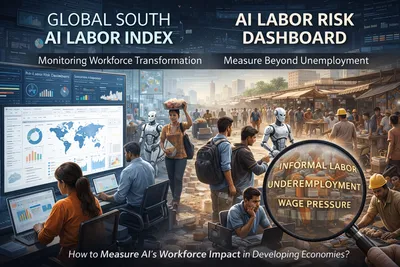
The Global South AI Labor Index: A Framework for Monitoring AI’s Workforce Impact
Artificial intelligence is beginning to reshape labor markets worldwide, yet most current studies measure its impact using indicators designed for advanced economies. In the Global South, workforce disruption is more likely to appear through rising informality, wage compression, underemployment, and shrinking entry-level opportunities rather than immediate job losses. This policy brief introduces the Global South AI Labor Index and an accompanying AI Labor Risk Dashboard to help governments detect early signals of AI-driven workforce transformation. Together, these tools provide a practical monitoring framework for managing the labor impacts of AI in developing economies.
AI and the Global South Workforce: The Next 10 Years
A Strategic Outlook for Labor, Development, and Artificial Intelligence