The Silent AI Shock in Workforce: An India Case Study
Why unemployment statistics will miss the real disruption of AI in the workforce in the Global South

AI in Workforce
Part 4 of 4
Table of Contents
- The Silent AI Shock in India’s Workforce
- 1. India’s Labor Structure: High Informality, Big IT Sector
- 2. A Composite Risk Score: India’s Vulnerability Profile
- 3. Informality and Hidden Distress
- 4. Youth: Fewer Graduates Entering Jobs
- 5. Sectoral Exposure: Services Under Strain
- 6. Digital Infrastructure: Enabler and Accelerator
- 7. Policy Takeaways for India
- 8. References
- 📥 AI in Workforce Series: The Silent AI Shock in India’s Workforce (PDF)
- 💬 Join the Conversation
- 🌍 Follow GlobalSouth.AI
- Subscribe to stay updated on new case studies, frameworks, and Global South perspectives on responsible AI.
The Silent AI Shock in India’s Workforce
Why unemployment statistics will miss the real disruption.
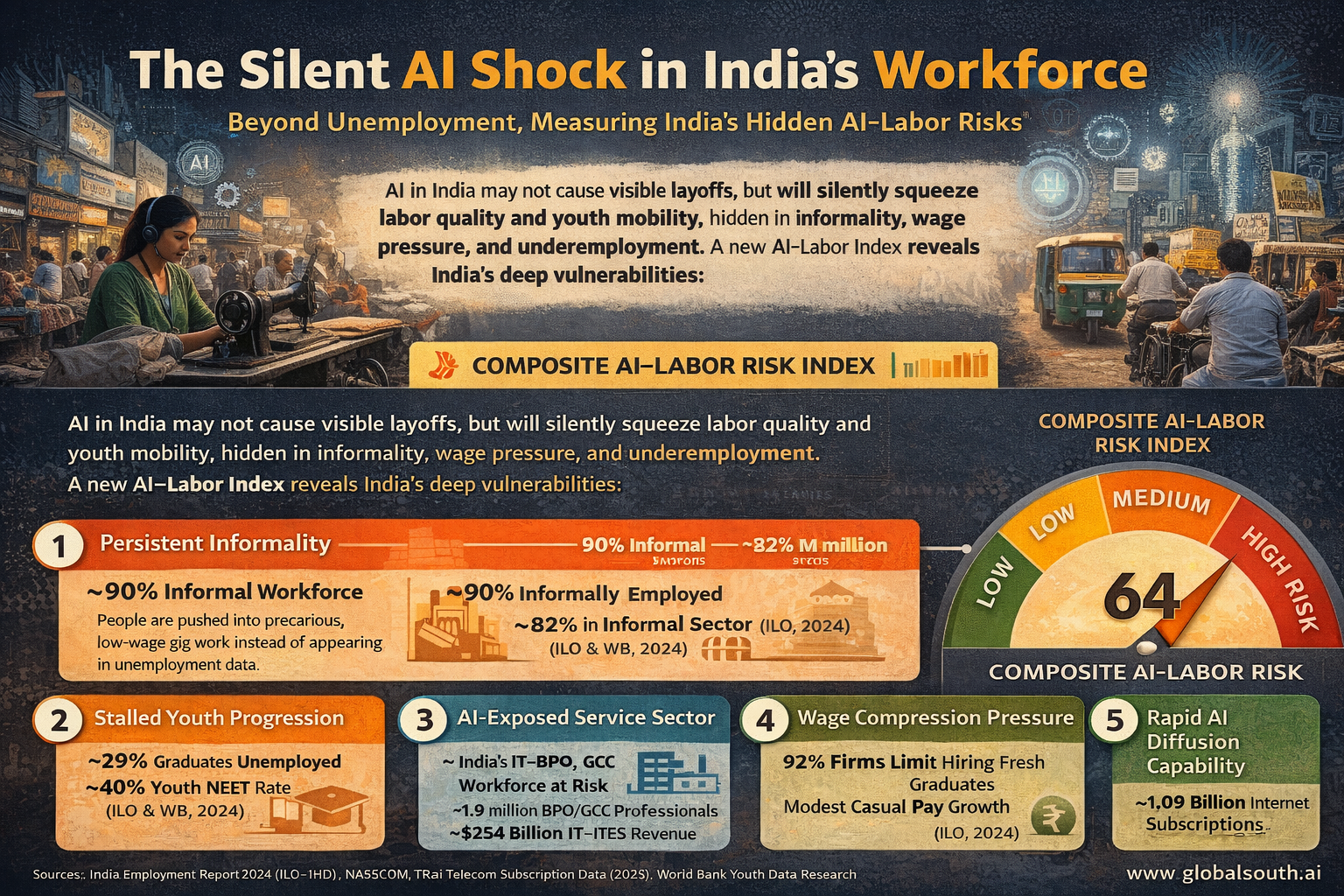
India’s labor market stands at a strategic inflection point. On one hand, it has a booming tech and services sector – IT/ITeS revenue now ~US$254 billion with 5.43 million workers [NASSCOM 2024], plus some 1.9 million employed in Global Capability Centres [NASSCOM GCC Report]. On the other hand, its workforce is overwhelmingly informal and fragmented. In 2022, only about 8–10% of Indian workers held formal employment, meaning roughly 90% of jobs are informal [ILO India Employment Report] [World Bank Informality Data]. This duality – a high-tech “head” and an informal “tail” – means that AI’s impact can be very different from richer countries.
Anthropic’s U.S.-centric analysis finds no immediate spike in unemployment [Anthropic Labor Study], but in India any AI-induced shocks are likely to hide in the informal margins: through underemployment, wage squeezes, and shifts into precarious gigs rather than clean layoffs. In short, India needs its own labor indicators for the AI era. Conventional metrics like the unemployment rate (around 3–5%) vastly understate distress. Instead, we should watch informality, working poverty, youth NEET, hours worked, and sectoral hiring patterns – signals aligned with Global-South realities [Anthropic Labor Study][ILO Future of Work].
Below we sketch India’s situation against these dimensions, illustrating why a composite “AI–Labor Index” would place India in a high-risk category. The country’s challenge is not visible mass layoffs today, but a quiet squeeze on job quality and youth mobility. Policymakers must heed these hidden indicators and act now to steer AI toward inclusive outcomes.
1. India’s Labor Structure: High Informality, Big IT Sector
India’s economy straddles two worlds. On one side, informal micro-enterprises and casual jobs dominate – roughly 8 in 10 workers are in the informal sector and nearly 90% are informally employed [ILO India Employment Report]. These include small farmers, street vendors, day laborers, domestic workers and unregistered self-employed. Such jobs come without contracts, social protection or stable wages, so any productivity shock tends to push people into even more precarious work rather than showing up in unemployment statistics.
On the other side is a vibrant formal tech-services engine. The NASSCOM industry body reports that India’s IT–ITeS sector earned ~US$254 billion in FY2024 and employs about 5.43 million people [NASSCOM 2024]. In addition, over 1,580 Global Capability Centres (GCCs) – corporate shared-services hubs – employ another 1.9 million skilled professionals [NASSCOM GCC Report]. These sectors formed the ladder for millions of graduates to enter the middle class. They cover exactly the kinds of routine knowledge and service tasks (coding, customer support, back-office data processing, etc.) that generative AI can automate or augment.
Meta-point: India is thus a prime case study of mixed leverage. Its formal tech sector is highly exposed to AI-driven automation, while its informal majority is acutely vulnerable to indirect effects (wage/underemployment). Measuring only unemployment would completely miss the story. (We illustrate a rough “AI–Labor Index” for India below.)
2. A Composite Risk Score: India’s Vulnerability Profile
To make this concrete, imagine scoring India on the six pillars of a Global South AI–Labor Index (Informality, Earnings Pressure, Youth, Sectoral Exposure, Underemployment, Digital Readiness). By most qualitative metrics, India would rank in the high-risk zone:
- Informality & Job Quality: ≈90% informal sector.
- Youth Employment: Very high. Youth unemployment is concentrated among the educated – e.g. in 2022 some 18.4% of secondary-educated and 29.1% of graduates were jobless [India Employment Report 2024].
- Sectoral Exposure: High. India’s export-oriented services employ millions in tasks AI can handle.
- Earnings Pressure: Moderately high. Wages in India have been largely stagnant [ILO Wage Trends].
- Underemployment/Gig Work: Moderately high. Many workers juggle multiple jobs or under-full-time work.
- Digital Readiness: Mixed. India had ~1.03 billion Internet subscriptions and ~1.01 billion broadband connections by 2025 [TRAI Telecom Report].
Taken together, India’s index score would be around ~60+ (on a 0–100 risk scale), signaling “high policy attention required.”
3. Informality and Hidden Distress
In mature economies, layoff counts and unemployment claims ring alarm bells. In India, workers slip between the cracks. Even if a firm uses AI to eliminate clerical jobs, affected workers rarely enter welfare rolls – they more often drop into casual labor, family enterprises, or ultra-precarious gigs. Official surveys illustrate this: despite strong GDP growth, India’s usual-status unemployment rate has remained low. But the labour force survey shows 82% in informal sector, ~90% informally employed [ILO India Employment Report].
Recommendation: India must bolster its labor monitoring beyond unemployment. Key metrics should include the informal employment share and working poverty rates. Strengthening social protection for informal workers will also be crucial to cushion these unseen shocks [ILO Social Protection Report].
4. Youth: Fewer Graduates Entering Jobs
A particularly acute concern is India’s youth transition. Millions of young Indians depend on entry-level “first rung” jobs in services to climb into the middle class. Generative AI is already able to perform core tasks of those entry roles. Indeed, recent U.S. data found a 14% drop in young workers’ job-finding in AI-exposed fields after ChatGPT’s launch [Anthropic Labor Study].
Empirical signs are already worrisome. The India Employment Report 2024 found that 18.4% of secondary-educated youth and 29.1% of college graduates were unemployed [India Employment Report 2024]. Meanwhile, roughly 40% of young people in India are NEET according to international labor estimates [World Bank Youth NEET Data].
5. Sectoral Exposure: Services Under Strain
India’s large service-export economy – IT, finance, contact centers – is a double-edged sword. These sectors propelled decades of growth but now place India on the front line of automation. NASSCOM data show ~$200 billion of tech exports in 2024 [NASSCOM 2024].
6. Digital Infrastructure: Enabler and Accelerator
India’s digital infrastructure is both an advantage and a risk factor. With over 1.03 billion Internet users and ~1.01 billion broadband connections [TRAI Telecom Report], AI adoption can spread rapidly.
Research from the World Bank highlights the importance of Connectivity, Compute, Data, and Skills in determining how countries benefit from AI [World Bank AI Readiness].
7. Policy Takeaways for India
India sits today in the high-alert zone of AI’s workforce impact map. Not because unemployment is spiking today, but because structural vulnerabilities are profound.
The central question for policymakers, educators, and industry leaders is clear:
Will we adapt our metrics and protections now, or let the silent squeeze erode our workforce under cover of stable unemployment?
8. References
NASSCOM (2024) – Indian IT–ITeS Industry Report
https://nasscom.in/knowledge-center/publications/technology-sector-report
NASSCOM Global Capability Centers Report
https://nasscom.in/knowledge-center/publications/gcc-india-report
ILO & Institute for Human Development (2024) – India Employment Report
https://www.ilo.org/publications/india-employment-report-2024
ILO Global Wage Report
https://www.ilo.org/global/research/global-reports/global-wage-report
ILO Social Protection Report
https://www.ilo.org/global/research/global-reports/world-social-protection-report
TRAI Telecom Subscription Data
https://www.trai.gov.in/release-publication/reports/performance-indicator-reports
Anthropic Economic Index – AI and Labour Market Analysis
https://www.anthropic.com/economic-index
World Bank – AI and the Future of Work
https://www.worldbank.org/en/topic/digitaldevelopment
World Bank Informality Database
https://www.worldbank.org/en/topic/jobs
World Bank Youth NEET Indicators
https://data.worldbank.org/indicator/SL.UEM.NEET.ZS
Related in this cluster
- The Global South AI Labor Index: A Framework for Monitoring AI’s Workforce Impact
- What Anthropic’s AI Jobs Study Misses in the Global South
- AI and the Global South Workforce: The Next 10 Years
- Browse all AI Workforce posts
📥 AI in Workforce Series: The Silent AI Shock in India’s Workforce (PDF)
👉 Download the Case Study Deck (PDF)
Stay tuned — new posts every week!
💬 Join the Conversation
Have thoughts, experiences, or questions about AI fairness? Share your comments, discuss with global experts, and connect with the community:
👉 Reach out via the Contact page
📧 Write to us: [email protected]
🌍 Follow GlobalSouth.AI
Stay connected and join the conversation on AI governance, fairness, safety, and sustainability.
- LinkedIn: https://linkedin.com/company/globalsouthai
- Substack Newsletter: https://newsletter.globalsouth.ai/
Subscribe to stay updated on new case studies, frameworks, and Global South perspectives on responsible AI.
Related Posts

AI in Healthcare in India: Opportunities, Risks, and Lessons for the Global South
A case study examining the opportunities, risks, regulations, and ecosystem of AI in healthcare in India.

What Anthropic’s AI Jobs Study Misses in the Global South
Anthropic’s recent study on AI and jobs offers valuable insights into how artificial intelligence may affect labor markets in advanced economies. But the same framework does not fully capture how workforce disruption unfolds in the Global South—where informality, youth employment pressures, and service outsourcing shape labor market realities.
The Global South AI Labor Index: A Framework for Monitoring AI’s Workforce Impact
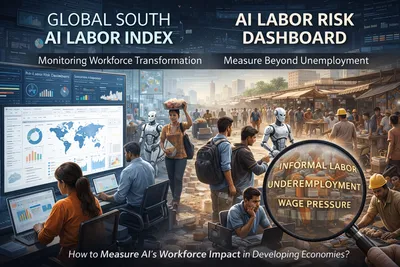
Artificial intelligence is beginning to reshape labor markets worldwide, yet most current studies measure its impact using indicators designed for advanced economies. In the Global South, workforce disruption is more likely to appear through rising informality, wage compression, underemployment, and shrinking entry-level opportunities rather than immediate job losses. This policy brief introduces the Global South AI Labor Index and an accompanying AI Labor Risk Dashboard to help governments detect early signals of AI-driven workforce transformation. Together, these tools provide a practical monitoring framework for managing the labor impacts of AI in developing economies.